Using Customer Growth Analytics to Connect Marketing Activity to Business Growth
Every dollar spent on marketing is a bet. You run a campaign, you push content, you buy ads, and you wait. The question that keeps business owners up at night is whether that money actually brought in new customers. Without a clear view of what happens after a prospect clicks, calls, or fills out a form, you are guessing. Customer growth analytics changes that. It gives you the ability to trace each lead back to the moment they first showed interest, and then follow their path through your pipeline until they become a paying customer.
For a business based in Charlotte, NC, or anywhere else, the gap between a strong marketing effort and actual revenue growth is often a lack of lead tracking. You might have a stellar website, a steady stream of calls, and a busy inbox. But if you cannot tell which channel sent each lead, how quickly they were contacted, and what finally made them buy, then you are flying blind. Growth analytics fills that gap by connecting the dots between marketing activity and business results.
What Customer Growth Analytics Means for Your Business
Customer growth analytics is the practice of using data about your leads and customers to understand how your marketing efforts contribute to revenue. It goes beyond vanity metrics like page views or social media likes. Instead, it focuses on the metrics that matter: conversion rate, acquisition cost, customer lifetime value, and the performance of each stage in your funnel. The goal is to know, with confidence, which activities actually drive growth and which ones are just noise.
Lead tracking sits at the heart of this approach. Without it, you cannot attribute a sale to a specific campaign, ad, or piece of content. With it, you build a clear map from the first touchpoint to the final purchase. That map becomes the foundation for every marketing decision you make going forward.
Step 1: Identify Every Lead Source
The first step is to catalog every way a potential customer can discover your business. This includes the obvious channels like Google ads, social media, email campaigns, and referrals. But do not overlook the less visible ones: a mention in a local blog, a review site, a directory listing, or even a conversation at a networking event. Each of these is a lead source that needs to be tracked.

What to watch for: Gaps in your tracking. If a prospect mentions they heard about you from a source you do not have tagged in your system, that is a sign you are missing something. Also look for sources that generate a lot of traffic but very few conversions. That discrepancy can point to a mismatch between your message and the audience on that channel.
Step 2: Set Up a Lead Pipeline
Once you know where leads come from, you need a structured way to move them through your process. A lead pipeline is a series of stages that every prospect passes through, from initial contact to becoming a customer. Typical stages include new lead, contacted, qualified, proposal sent, negotiation, and closed. The exact stages depend on your business model, but the principle is the same: you need to track where each lead is at any given moment.
What to watch for: Bottlenecks. If leads get stuck at a particular stage, it signals a problem. Maybe your response time is too slow, your follow-up process is inconsistent, or your pricing is unclear. A pipeline makes these issues visible so you can address them. Also watch for leads that skip stages or move backwards; that often means your qualification criteria are not well defined.
Step 3: Implement Lead Source Attribution
Attribution is the process of assigning credit for a lead or sale to the marketing activity that generated it. There are different models, but the simplest and most practical for most small and medium businesses is first-touch attribution. That means the first source a lead came from gets the credit for that lead. More advanced models, like multi-touch attribution, distribute credit across several touchpoints in the customer journey.
What to watch for: Over-reliance on one model. First-touch attribution is easy but can overvalue top-of-funnel channels like social media or display ads, while undervaluing the efforts that actually close the deal, like email nurturing or sales calls. Consider using a simple multi-touch model that gives partial credit to the first and last interactions. Also watch for data quality: if your tracking is broken or incomplete, attribution will be misleading.
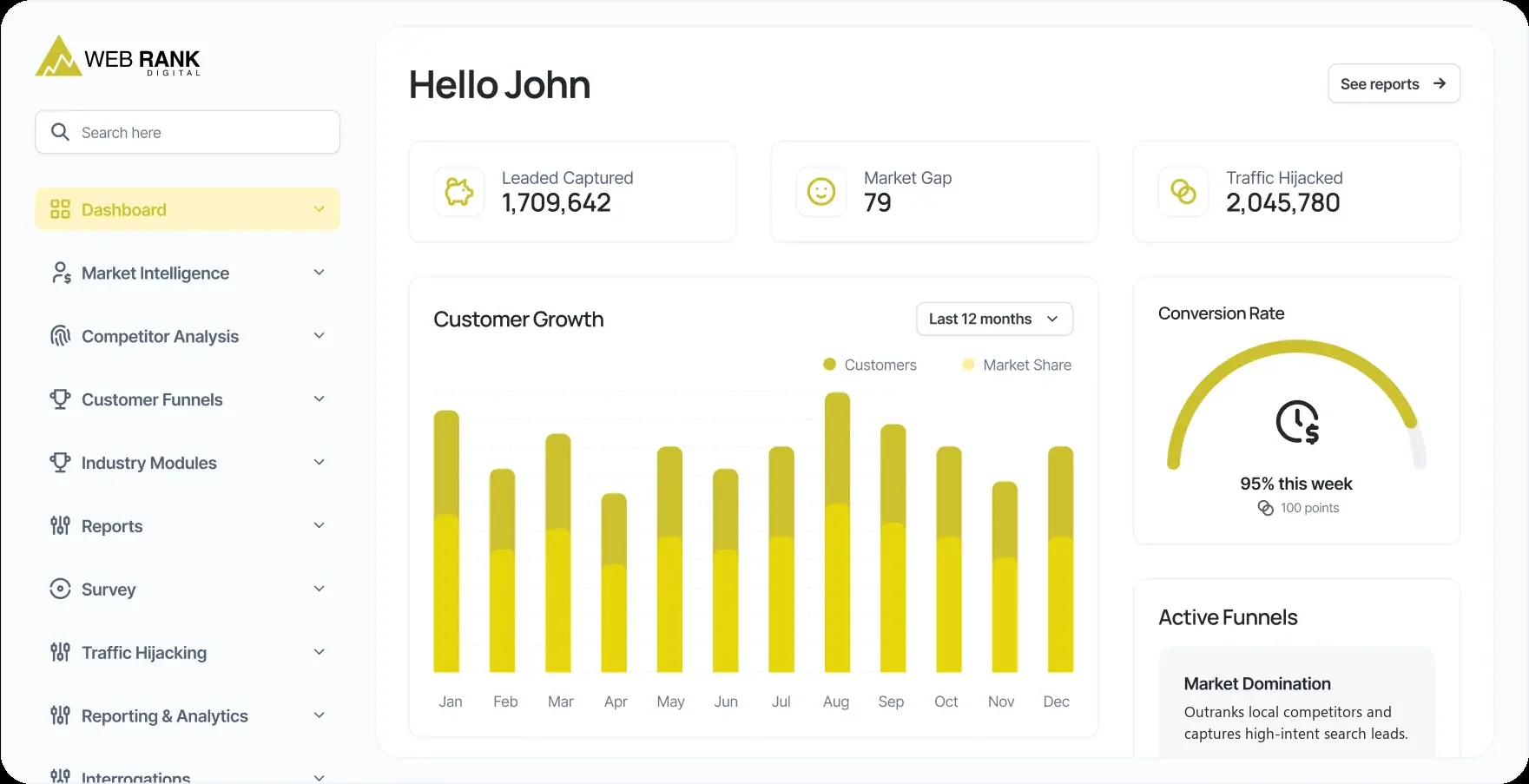
One way to get this right is by using a platform designed for customer acquisition analytics. Web Rank Digital provides tools that help businesses capture, convert, and scale their customer base by automating the attribution and pipeline management process. Their platform includes a market intelligence engine that delivers AI-powered insights into where your best leads are coming from, so you can focus your marketing budget on the channels that actually work.
Step 4: Measure What Matters: Conversion Rate, Acquisition Cost, and Lifetime Value
With attribution in place, you can start calculating the metrics that directly reflect business growth. Conversion rate tells you the percentage of leads that become customers at each stage. Acquisition cost is the total marketing spend divided by the number of new customers. Customer lifetime value is the total revenue you expect from a single customer over the course of your relationship.
What to watch for: Comparing these metrics across channels. A channel with a low conversion rate but a very low acquisition cost might still be profitable, especially if those customers have a high lifetime value. Also watch for changes over time. A rising acquisition cost could mean your ads are becoming less effective or that your targeting needs refreshing. A falling customer lifetime value might indicate a product or service quality issue that needs attention.
Step 5: Build a Reporting Dashboard
A reporting dashboard brings all your data together in one place. It shows you, at a glance, how your pipeline is performing, which sources are delivering the best return, and where you need to make adjustments. The dashboard should be updated in real time or at least daily, so you can react quickly to trends.
What to watch for: Dashboard clutter. It is tempting to include every possible metric, but that makes it hard to spot the signal in the noise. Focus on the five to seven metrics that matter most for your business right now. Also watch for data that contradicts itself. If your dashboard shows a high conversion rate but falling revenue, something is off in your tracking or your calculations.
Step 6: Use the Data to Optimize Your Marketing
The final step is to act on what you learn. If a particular lead source consistently produces customers with a high lifetime value, increase your investment there. If another source generates many leads but few sales, either improve your messaging for that audience or shift that budget elsewhere. The same goes for each stage of your pipeline: if prospects drop off after a proposal is sent, work on your proposal content or your pricing presentation.
What to watch for: Confirmation bias. It is easy to fall in love with a channel or a campaign and ignore data that says it is underperforming. Let the numbers guide your decisions, not your gut. Also watch for seasonal patterns. A spike in conversions during a holiday period might not mean your new campaign is working; it could simply be normal seasonal demand. Compare year-over-year data to separate real growth from seasonal noise.

Bringing It All Together for Growth
Customer growth analytics is not a one-time project. It is an ongoing practice of measuring, learning, and adjusting. The businesses that grow consistently are the ones that treat lead tracking as a core part of their operations, not as an afterthought. They know exactly which marketing activities drive revenue and which ones drain resources. They use that knowledge to make smarter decisions every day.
If you are based in the Charlotte area and want to put these steps into practice, you can reach Web Rank Digital at 401 s Graham st, Charlotte, NC 28202, or call +1 877-726-5871 to discuss tools that can automate your lead tracking and growth analytics.
Web Rank Digital is also on Facebook.